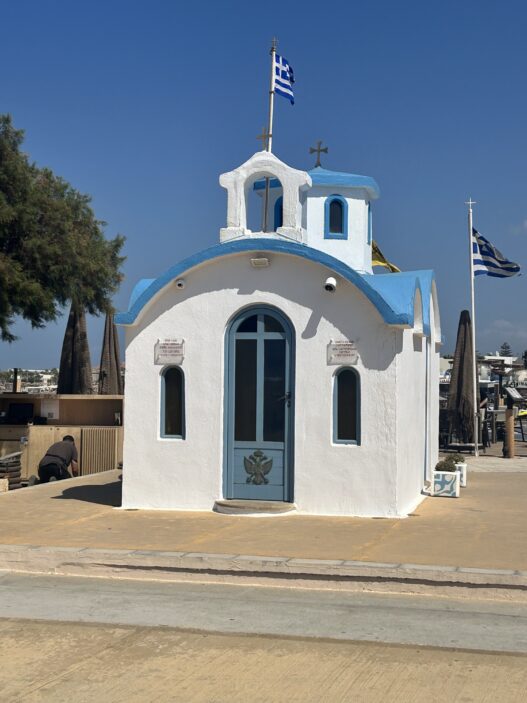
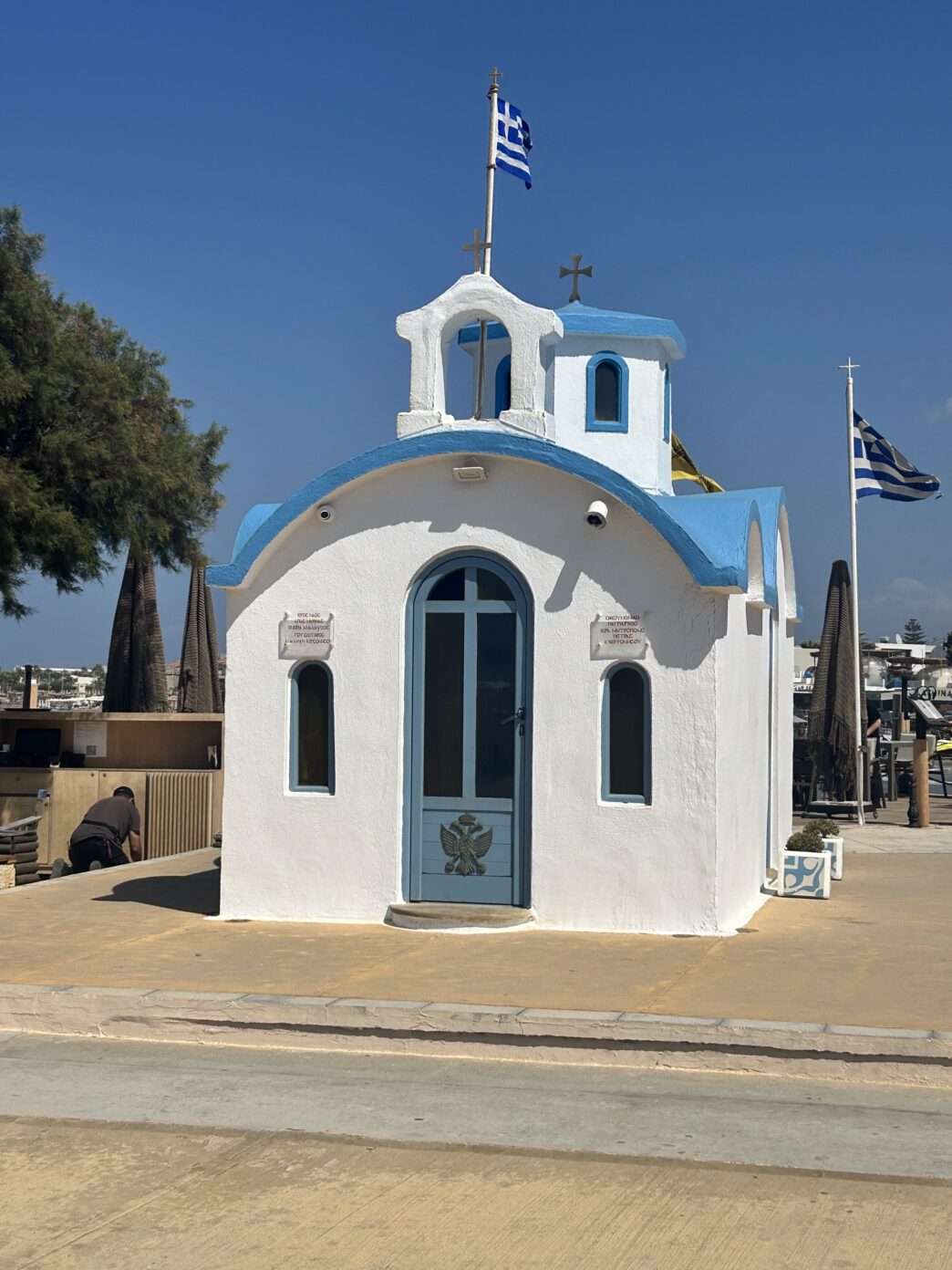
There are certain things you expect to find when travelling around Crete: beautiful beaches, mountainous landscapes, traditional villages, incredible food and seemingly endless stretches of blue sky.
What I hadn’t quite expected was just how often I would come across small chapels.
They appear almost everywhere.
Along winding roads, amongst olive groves, high in the mountains, beside the sea, tucked quietly between houses and sometimes seemingly sitting completely alone, miles away from anywhere.
Some are beautifully whitewashed, while others are constructed from stone and appear almost to have grown naturally from the Cretan landscape. Some are incredibly simple inside, while others are filled with religious icons, candles, oil lamps and intricate decoration.
One of the things I found particularly beautiful was that many of these chapels could simply be entered.
You could quietly step inside, light a candle, leave a small donation and spend a few moments in prayer.
No grand ceremony was required. 
Just you, your thoughts and a moment of stillness.


Christianity Has Deep Roots in Crete
To understand why these little churches and chapels are such a visible part of Crete, you have to look back at the island’s long religious history.
Christianity has been connected with Crete since the earliest centuries of the faith, with Saint Titus traditionally regarded as the first bishop of Crete and an important figure in the development of Christianity on the island.
Over time, the Orthodox Christian faith became deeply woven into Cretan life.
It was never simply something practised inside large churches on Sundays. Faith became connected to families, villages, landscapes, journeys, celebrations and significant moments in people’s lives.
That helps to explain why sacred spaces can be found in some of the most unexpected locations.
In Crete, religion and the landscape often seem to exist side by side.


Why Are There So Many Small Chapels in Crete?
There isn’t one single reason.
Some chapels have existed for centuries, while others are much more recent. Some belong to villages or monasteries, some have been constructed by families and others were created as acts of devotion.
Across the island, small rural churches have survived from different periods in Crete’s history, including the Venetian and Ottoman eras.
Many were relatively modest buildings, created using local materials and designed to serve small communities.
Yet what may appear simple from the outside can be completely different once you step through the door.
Inside, you may find icons depicting Christ, the Virgin Mary and saints, along with candles, incense, religious paintings and oil lamps.
Some older chapels even contain beautiful examples of Byzantine and post-Byzantine religious artwork.
That contrast is one of the things that makes them so fascinating.
They were not necessarily built to be grand or impressive.
They were built to mean something.


Chapels Dedicated to Saints
Many chapels throughout Crete are dedicated to a particular saint.
Saints hold an important place within Orthodox Christianity, and churches may hold special services and celebrations on the feast day of the saint to whom they are dedicated.
In some areas, these feast days become much more than a religious service.
Families and local communities may come together to worship, eat, celebrate and spend time with one another.
It means that a tiny chapel that looks completely silent when you discover it while travelling could become the centre of community life on a particular day of the year.
I love that thought.
These seemingly quiet buildings may have witnessed generations of families, prayers, celebrations, grief, gratitude and memories.

Chapels Built as Acts of Gratitude
Another beautiful part of this tradition is that some small chapels and shrines may be connected to personal acts of faith.
Some have been built in gratitude after a prayer was believed to have been answered, while others may have been created after someone survived an illness, accident or difficult experience.
A family may also build or maintain a chapel dedicated to a saint who holds particular significance to them.
Knowing this changes the way you look at these little buildings.
Behind one chapel could be the story of someone who prayed throughout an illness.
Another may represent a family’s gratitude.
Another might exist in memory of someone who was deeply loved.
Another may simply have been built because a family wanted somewhere sacred in which they could pray.
When you come across these spaces as a visitor, you may never know the individual story behind them.
But knowing that there may be a very personal story attached to the chapel makes them feel even more special.
The Roadside Shrines of Crete
As you travel around Crete, you may also notice very small religious shrines positioned alongside roads.
These are different from the larger chapels that you can physically enter.
Some roadside shrines mark the location of a traffic accident. In certain cases, they may have been placed there by somebody who survived the accident as an expression of gratitude.
Others may have been created as memorials for somebody who sadly lost their life.
Inside, there may be an icon, an oil lamp, flowers or even a photograph.
They are another reminder of how closely faith, remembrance and the landscape are connected in Crete.
As you travel through the island, it can sometimes feel as though people’s stories have become part of the landscape itself.
Lighting a Candle in a Greek Orthodox Chapel
One of my favourite experiences was simply being able to enter a chapel and light a candle.
There is something incredibly peaceful about the simplicity of the act.
You step inside.
Choose a candle.
Leave a small donation where appropriate.
Light the candle.
And pray.
Candles hold important symbolism within Orthodox Christianity and can represent prayer, faith, light and devotion.
But even if you do not understand every religious tradition attached to the practice, there is something universally meaningful about lighting a candle.
You may light one for someone you love.
For someone you have lost.
For healing.
For protection.
For guidance.
For strength.
Or simply to say thank you.
For me, it became less about doing something and more about allowing myself to simply be still.
And stillness is something we do not always give ourselves enough of, particularly when travelling.
A Different Kind of Travel Experience
Travel can sometimes become incredibly fast-paced.
We make itineraries.
We search for the best restaurants.
We photograph everything.
We make lists of all the places we want to see before we return home.
We move from one destination to another, constantly thinking about what comes next.
And somewhere amongst all of that, it can become easy to forget to actually experience where we are.
Walking into one of Crete’s little chapels felt like the opposite of that.
For a few minutes, there was nothing to achieve.
There was no attraction to tick off my list.
There was no need to rush to the next destination.
There was no perfect photograph that needed to be taken.
There was simply silence.
It reminded me that some of the most memorable parts of travelling are not always the biggest attractions.
Sometimes they are tiny rooms containing little more than a handful of icons and the flickering light of a candle.
A Faith That Has Survived Through Generations
Crete has experienced an incredibly complex history.
The island has been ruled by different powers over the centuries, including periods of Venetian and Ottoman rule.
Throughout those changes, religion continued to play an important role in the lives of local people.
Churches and chapels became places where traditions could continue, communities could gather and faith could be preserved across generations.
That history gives these little chapels even greater significance.
They are not simply beautiful buildings dotted across the landscape.
Many represent continuity.
Generations of people have prayed inside them.
Candles have been lit.
Icons have been cared for.
Feast days have been celebrated.
Families have gathered.
People have asked for help, given thanks and remembered loved ones.
And many of those traditions remain alive today.
Faith Is Written Into the Cretan Landscape
Perhaps this was one of the biggest things I took away from seeing these chapels.
In Crete, faith is not always contained behind the enormous doors of an impressive cathedral.
Sometimes it is sitting quietly on the side of a mountain.
Sometimes it is waiting at the end of a dusty road.
Sometimes it is hidden amongst olive trees.
Sometimes it sits beside the sea.
And sometimes it is positioned beside a road that thousands of people travel along every year.
Someone may have been quietly looking after that chapel for decades.
Replacing candles.
Cleaning the space.
Maintaining the icons.
Opening the door.
Keeping a tradition alive.
There is something incredibly beautiful about that.
Visiting the Chapels Respectfully
Although many chapels welcome visitors, it is important to remember that these are not simply tourist attractions.
They are places of worship.
If you find one open, enter respectfully.
Keep noise to a minimum and be mindful of anyone who may be praying.
Dress respectfully where possible and avoid treating the chapel simply as somewhere to take photographs.
If you want to take pictures inside, it is always worth checking whether photography is permitted first.
If candles are available and visitors are invited to light one, you may also find somewhere to leave a small donation.
And once you have lit your candle, give yourself a few minutes.
You do not need to rush straight back outside.
Stand there.
Reflect.
Pray.
Give thanks.
Or simply enjoy the stillness.
The Crete I Will Remember
When I think about Crete, naturally I remember the sunshine.
The beautiful blue water.
The incredible landscapes.
The food.
The warm evenings.
And my beautiful stay at Stella Blue.
But increasingly, I realise that I will also remember these quieter moments.
Opening the door of a tiny chapel.
Stepping inside and escaping the heat for a few minutes.
Standing in silence.
Seeing generations of religious imagery surrounding me.
Lighting a candle.
Saying a prayer.
And feeling, just for a little while, completely still.
Travel is not always about finding somewhere spectacular.
Sometimes, the places that stay with us are the smallest ones.
And scattered throughout Crete are countless little reminders that some of the most beautiful experiences are the ones that simply invite us to stop, reflect and be grateful. 🤍🙏
Read more of my Crete Travel Series HERE